
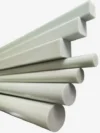
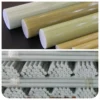



Fiberglass Dowel Bar – Corrosion-Proof GFRP Load Transfer Solution for Concrete Pavements
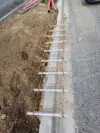
In concrete slab construction—whether on grade, elevated, or otherwise—joints such as expansion and contraction joints are intentionally placed to control cracking and slab movement. In many designs, dowel bars are cast across transverse joints to restrain vertical movement between adjacent slabs while still allowing horizontal movement.
Traditionally, these dowel bars are made of plain or coated steel. Despite protective coatings, steel dowels remain vulnerable to corrosion, which can lock joints, cause concrete spalling, and lead to premature pavement failure. Pulwell fiberglass (GFRP) dowel bars are engineered specifically to eliminate these issues by providing a corrosion-proof alternative for long-life pavement systems .
Function of Fiberglass Dowel Bars in Concrete Joints
Pulwell GFRP dowel bars:
-
Restrain vertical movement between adjacent concrete slabs
-
Permit controlled horizontal slab movement
-
Transfer shear forces across transverse joints
-
Reduce stress concentration in surrounding concrete
Unlike steel dowels, Pulwell GFRP dowel bars do not rust or expand, preventing joint locking and concrete damage over time .
Key Advantages Over Steel Dowel Bars
| Advantage | Description |
|---|---|
| Corrosion Proof | Impervious to rust, chloride ions, and chemical attack |
| Lightweight | Approximately 1/4 the weight of steel dowels |
| Safer Handling | Reduced injuries during transport and installation |
| Faster Installation | Easier placement with less labor |
| No Greasing Required | Eliminates greasing before concrete placement |
| Reduced Concrete Stress | Lower stiffness reduces fatigue stresses |
| Improved Joint Durability | Prevents spalling and joint failure |
These advantages directly address the most common failure mechanisms in concrete pavement joints .
Material Behavior and Structural Benefits
Pulwell GFRP dowel bars have a modulus of elasticity closer to concrete than steel, resulting in:
-
Reduced stress concentrations around the dowel
-
Lower fatigue damage in surrounding concrete
-
Compatibility with lower-strength concrete designs
This mechanical compatibility improves long-term pavement performance and durability .
Mechanical and Physical Properties
| Property | Typical Value |
|---|---|
| Tensile Strength | > 900 MPa |
| Tensile Modulus | > 45 GPa |
| Barcol Hardness | 55 (ASTM D2583) |
| Glass Fiber Content | ≥ 70% by weight (ASTM D2584) |
| Specific Gravity | 2.00 – 2.10 (ASTM D792) |
| Coefficient of Thermal Expansion (Longitudinal) | 9.07 × 10⁻⁶ /°C |
| Coefficient of Thermal Expansion (Transverse) | 21–23 × 10⁻⁶ /°C |
| Shear Strength | Verified by short beam and double shear tests |
Pulwell Grade II GFRP dowel bars comply with ASTM D8444 / D8444M requirements .
Why Fiberglass Dowel Bars Extend Pavement Life
| Aspect | GFRP Dowel Bar | Steel Dowel Bar |
|---|---|---|
| Corrosion Resistance | Complete | Limited |
| Joint Locking Risk | None | High |
| Concrete Spalling | Minimized | Common |
| Weight | Very light | Heavy |
| Fatigue Stress | Reduced | Higher |
| Maintenance Needs | Minimal | Frequent |
| Service Life | Extended | Limited |
Conclusion:
Fiberglass dowel bars eliminate the primary weakness of concrete pavements—the joint—by removing corrosion as a failure mechanism.
Applications of Pulwell GFRP Dowel Bars
Pulwell fiberglass dowel bars are used in:
-
Jointed rigid concrete pavements
-
Dowel bar retrofit projects
-
High-speed toll roads
-
Automatic and wire-guided vehicle areas
-
Industrial floors and logistics yards
-
Marine and coastal concrete exposed to chlorides
-
Canals, posts, and desalination facilities
They are especially suitable for aggressive environments where steel dowels deteriorate rapidly .
Installation Guidelines
-
Position dowel bars centered across transverse joints.
-
Align dowels to ensure free horizontal joint movement.
-
Secure using baskets or alignment systems as specified.
-
Place concrete without greasing or coating requirements.
-
Allow normal curing and joint operation.
No epoxy coating, galvanizing, or lubrication is required.
Customer Benefits
-
Extended pavement and joint service life
-
Reduced maintenance and repair costs
-
Faster installation and safer handling
-
Improved long-term load transfer performance
-
Reliable performance in corrosive environments
-
Compliance with recognized ASTM standards
Frequently Asked Questions (FAQs)
Q1: Why do steel dowel bars fail in concrete pavements?
Primarily due to corrosion, which causes joint locking and concrete spalling.
Q2: Do fiberglass dowel bars transfer load effectively?
Yes. They provide sufficient shear capacity while reducing fatigue stress.
Q3: Are Pulwell GFRP dowel bars affected by chlorides?
No. They are impervious to chloride ion and chemical attack.
Q4: Is greasing required before installation?
No. Greasing is not required for GFRP dowel bars.
Q5: Are these dowel bars ASTM compliant?
Yes. Pulwell Grade II GFRP dowel bars comply with ASTM D8444/D8444M.
Q6: Can they be used in retrofit projects?
Yes. They are suitable for both new construction and dowel bar retrofits.
External Reference
For general guidance on concrete pavement joints and load transfer, visit:
https://www.fhwa.dot.gov
Summary
-
Corrosion-proof GFRP fiberglass dowel bars
-
Lightweight and easy to install
-
Reduced concrete fatigue and joint stress
-
No greasing or coatings required
-
Ideal for long-life concrete pavements and harsh environments