
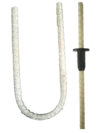
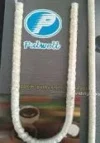
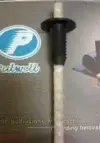


Composite Wall Ties / Form Ties – GFRP Connectors for Precast Concrete Sandwich Walls
Composite wall ties, also referred to as composite form ties, are structural connectors used in precast concrete sandwich panel (PCSP) systems. These systems typically consist of two concrete wythes with an insulation layer placed in between. The wall ties pass through the insulation layer to connect the inner and outer concrete wythes, enabling composite action and shared load resistance.
Pulwell manufactures unique glass fiber reinforced polymer (GFRP) wall ties specifically designed to replace traditional metal form ties. These composite connectors resist interface shear forces while significantly improving thermal efficiency and durability compared to steel alternatives .
Role of Composite Wall Ties in Sandwich Wall Construction
In composite precast construction:
-
The two concrete wythes act together structurally
-
Shear forces generated by composite action must be transferred reliably
-
Wall ties serve as the critical load-transferring elements
Pulwell composite wall ties are engineered to provide high bond strength with concrete while maintaining insulation integrity and long-term performance in aggressive environments .
Key Features and Advantages Over Metal Form Ties
| Feature | Description |
|---|---|
| Natural Thermal Insulator | Minimizes thermal bridging through the wall assembly |
| Magnetically Transparent | Suitable for MRI, medical, and sensitive environments |
| RF Transparent | Does not interfere with wireless or communication signals |
| Corrosion Resistant | No rust, oxidation, or chemical degradation |
| No Patching Required | Eliminates post-construction plugging and repairs |
| High Strength | Capable of resisting interface shear forces |
| Lightweight | Easy handling and faster installation |
| Superior Bond Strength | Much higher bond strength with concrete than metal ties |
| Low Thermal Expansion | Reduces cracking and long-term stress |
| Low Thermal Conductivity | Improves overall wall energy efficiency |
These advantages make composite wall ties an energy-efficient and durable alternative to traditional metal connectors .
Compatibility with Insulated Concrete Systems
Pulwell composite wall ties are fully compatible with:
-
Thermomass® insulation systems
-
Similar sandwich-style concrete wall insulation systems
-
Various concrete forming systems used in precast construction
This compatibility allows seamless integration into existing production lines without major design changes .
Material and Construction
| Parameter | Description |
|---|---|
| Material | Glass Fiber Reinforced Polymer (GFRP) |
| Conductivity | Non-metallic, non-conductive |
| Magnetic Properties | Non-magnetic |
| Chemical Resistance | Excellent |
| Corrosion Resistance | Complete immunity to rust |
| Structural Behavior | High shear resistance with low thermal transfer |
The GFRP material composition ensures long-term performance in both interior and exterior wall assemblies.
Applications of Composite Wall Ties / Form Ties
Composite wall ties are widely used in:
-
Precast concrete sandwich wall panels
-
Energy-efficient building envelopes
-
Industrial and commercial buildings
-
Cold storage and temperature-controlled facilities
-
Hospitals and medical buildings
-
Data centers and RF-sensitive structures
-
Infrastructure and institutional construction
They are particularly effective in applications where thermal efficiency, durability, and corrosion resistance are critical.
Why Choose GFRP Composite Wall Ties Instead of Metal?
| Aspect | Composite Wall Ties | Metal Form Ties |
|---|---|---|
| Thermal Bridging | Minimal | High |
| Corrosion | None | Prone to rust |
| Magnetic Interference | None | Present |
| RF Interference | None | Possible |
| Maintenance | None | Requires patching |
| Service Life | Long-term | Limited |
| Energy Efficiency | High | Low |
Conclusion:
Composite wall ties significantly improve building performance, durability, and energy efficiency compared to traditional metal form ties.
Installation and Handling Guidelines
-
Install composite wall ties according to panel design spacing.
-
Insert ties through insulation to connect both concrete wythes.
-
Ensure proper embedment length for optimal bond strength.
-
Pour concrete without concern for corrosion or thermal bridging.
-
No cutting, patching, or plugging required after form removal.
These ties simplify installation while improving overall construction quality.
Customer Benefits
-
Improved thermal performance of sandwich panels
-
Reduced long-term maintenance costs
-
Enhanced durability in aggressive environments
-
Compatibility with established insulation systems
-
Faster production and cleaner finishes
-
Long service life with stable structural behavior
Frequently Asked Questions (FAQs)
Q1: What are composite wall ties used for?
They connect the inner and outer concrete wythes in precast sandwich wall panels while transferring shear forces.
Q2: Are composite wall ties stronger than metal ties?
They offer high structural strength with superior bond performance and without corrosion issues.
Q3: Do composite wall ties reduce thermal bridging?
Yes. They have much lower thermal conductivity than metal ties.
Q4: Are these ties compatible with Thermomass® systems?
Yes. They are fully compatible with Thermomass® and similar systems .
Q5: Is patching required after installation?
No. Composite wall ties eliminate the need for patching or plugging.
Q6: Are they suitable for RF-sensitive buildings?
Yes. They are magnetically and RF transparent.
